Speed Is No Longer a Startup Advantage. Clarity Is.

Most Startups Have Learned to Ship Fast. Very Few Have Learned to Ship Clearly.
Startups were told to move faster. Most did. Today, MVPs ship in weeks, interfaces appear in days, and products go live before teams fully agree on what they’re building.
Speed is no longer the bottleneck. Clarity is.
It’s easy to ship something. It’s hard to ship something coherent. We increasingly see products that look impressive but feel structurally fragile. Features overlap. Interaction logic contradicts itself. Teams move quickly, but much of that speed is spent undoing what they just built.
After working with AI and SaaS startups, one pattern is consistent: startups rarely fail because they can’t ship. They struggle because what they ship lacks internal structure.

The Hidden Bottleneck No One Talks About
Founders often assume the biggest risk is technical complexity. In practice, the more dangerous risk is structural chaos. Early products are frequently built without a real design system, not because founders underestimate its importance, but because they are trying to move fast. Ironically, this decision is what slows them down later.
Without structure, every new feature introduces fresh design debates. Every screen becomes a negotiation between product intuition and engineering constraints. Every iteration becomes more expensive than the previous one. This is not design debt. It is velocity debt. In venture environments, velocity is the only currency that compounds.
This execution pressure is only increasing as product cycles accelerate globally.
AI Adoption Is Reshaping Product Velocity
55% of organizations report using AI in at least one function, with product development among the fastest-growing areas.
Source: Stanford AI Index Report 2024
As AI lowers the cost of shipping features, the cost of shipping chaos drops too. Startups now have the ability to move faster than ever — but also to accumulate complexity faster than ever.

MVPs Are Not Prototypes Anymore
A decade ago, an MVP could be rough. Today, early product quality sends immediate signals to investors, customers, and future hires. An inconsistent interface signals execution risk. Fragmented UX signals scaling risk. An unfinished experience signals leadership risk.
Users are not benchmarking startups against other startups. They are benchmarking them against the best software they use daily.
Product Experience Directly Impacts Retention73% of consumers say customer experience is a key factor in purchasing decisions.
Source: PwC Global Consumer Insights Pulse Survey 2024
In startup terms, this means UX quality is no longer a “polish phase.” It is a growth lever from day one.

AI Speeds Up Output. It Also Speeds Up Chaos.
AI can now generate layouts, flows, and entire interface concepts within seconds. This creates an illusion of velocity. Teams assume that faster interface generation equals faster product execution. In reality, AI often accelerates the very problems that slow startups down.
Without a system, AI produces fragmented interaction patterns, unscalable component structures, and visual decisions disconnected from product strategy. Early progress feels fast. Then complexity compounds. Then redesign becomes inevitable.
This is not theoretical. Product organizations consistently report that shipping more does not automatically create value.
Feature Output ≠ Product Value45% of product teams say they struggle to prioritize the right features due to limited customer insight.
Source: Amplitude Product Report 2024
AI increases output capacity. It does not replace prioritization or product architecture.

Design Systems Are Not “Nice to Have.” They Are Leverage.
A real design system is not a UI library. It is a mechanism for compressing decision-making across the product organization. It allows teams to ship features without redefining interaction logic each time. It enables products to scale without losing coherence. It reduces onboarding friction for engineers. It accelerates experimentation and learning cycles.
In AI products, this becomes critical much earlier. Agent workflows, multi-step reasoning interactions, and data-dense interfaces introduce complexity that grows exponentially. Without structural design architecture, this complexity turns into entropy. With a system, it becomes capability.
Why Founders Invest in Structure Too Late
There is a persistent belief that design systems are a later-stage concern. Something to address after product-market fit, or during a larger funding stage. In reality, retrofitting structure into a rapidly growing product is one of the most expensive and disruptive exercises a startup can face. It slows teams precisely when acceleration is most critical.
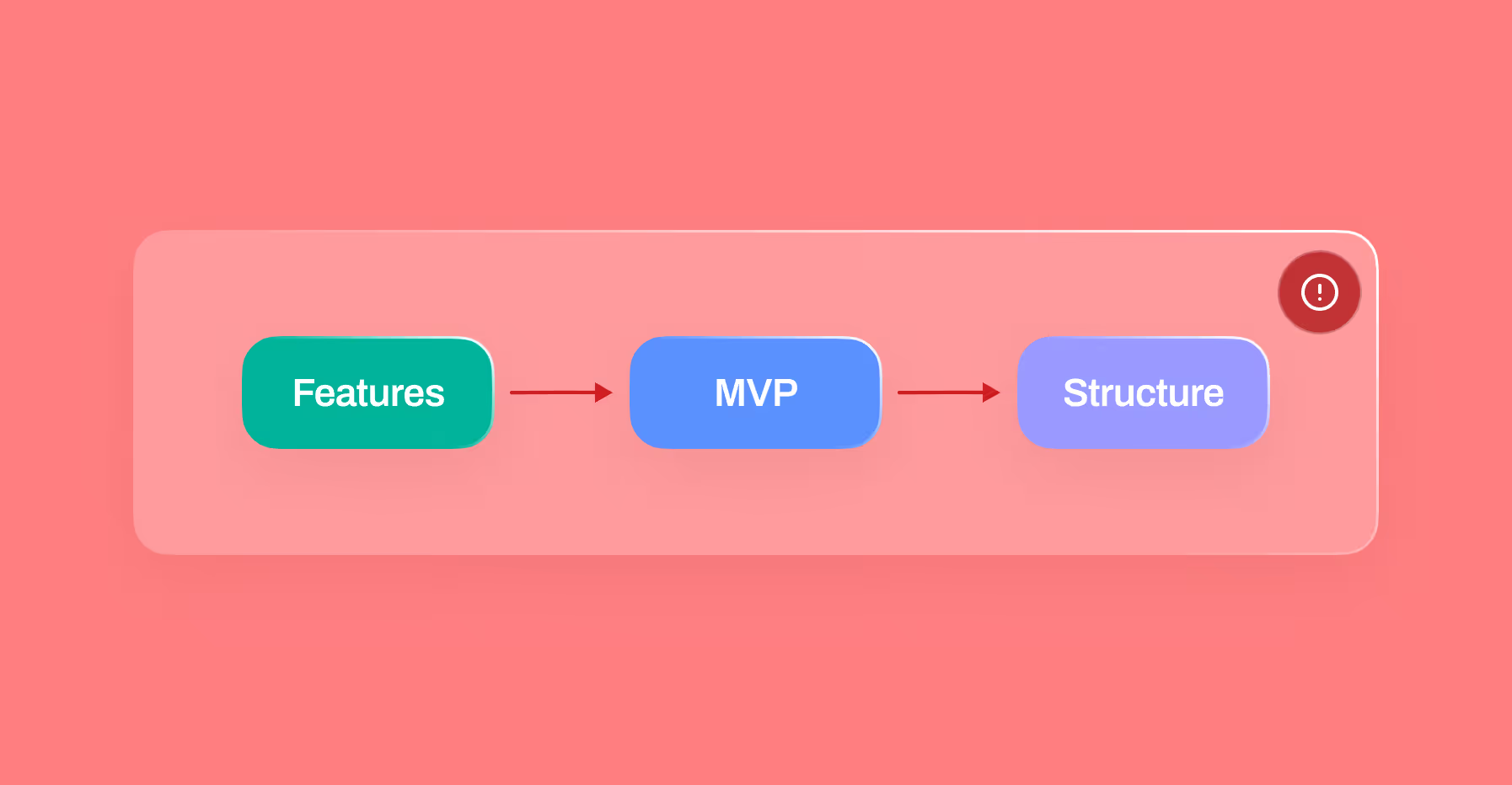
We often see the same inflection point. Traction begins to appear. Engineering velocity drops. UX inconsistencies multiply. A large redesign becomes inevitable. This scenario is not a growth problem. It is a structural one. And it is preventable, but only if system thinking starts early.

How Peppermint Builds MVPs That Can Actually Scale
At Peppermint, we do not approach MVP design as a one-time sprint. We treat it as the early architecture of a product company. Our work focuses on modular interaction patterns aligned with real workflows, scalable visual systems that survive rapid iteration, component logic suited for engineering environments, and UX clarity tailored to technical audiences.
In many engagements, we operate as a fractional design partner. Not just delivering screens, but helping shape how the product evolves over time. Because the real challenge is not launching version one. It is ensuring version ten still makes sense.
Venture Speed Is Not About Launching Faster. It Is About Iterating Faster.
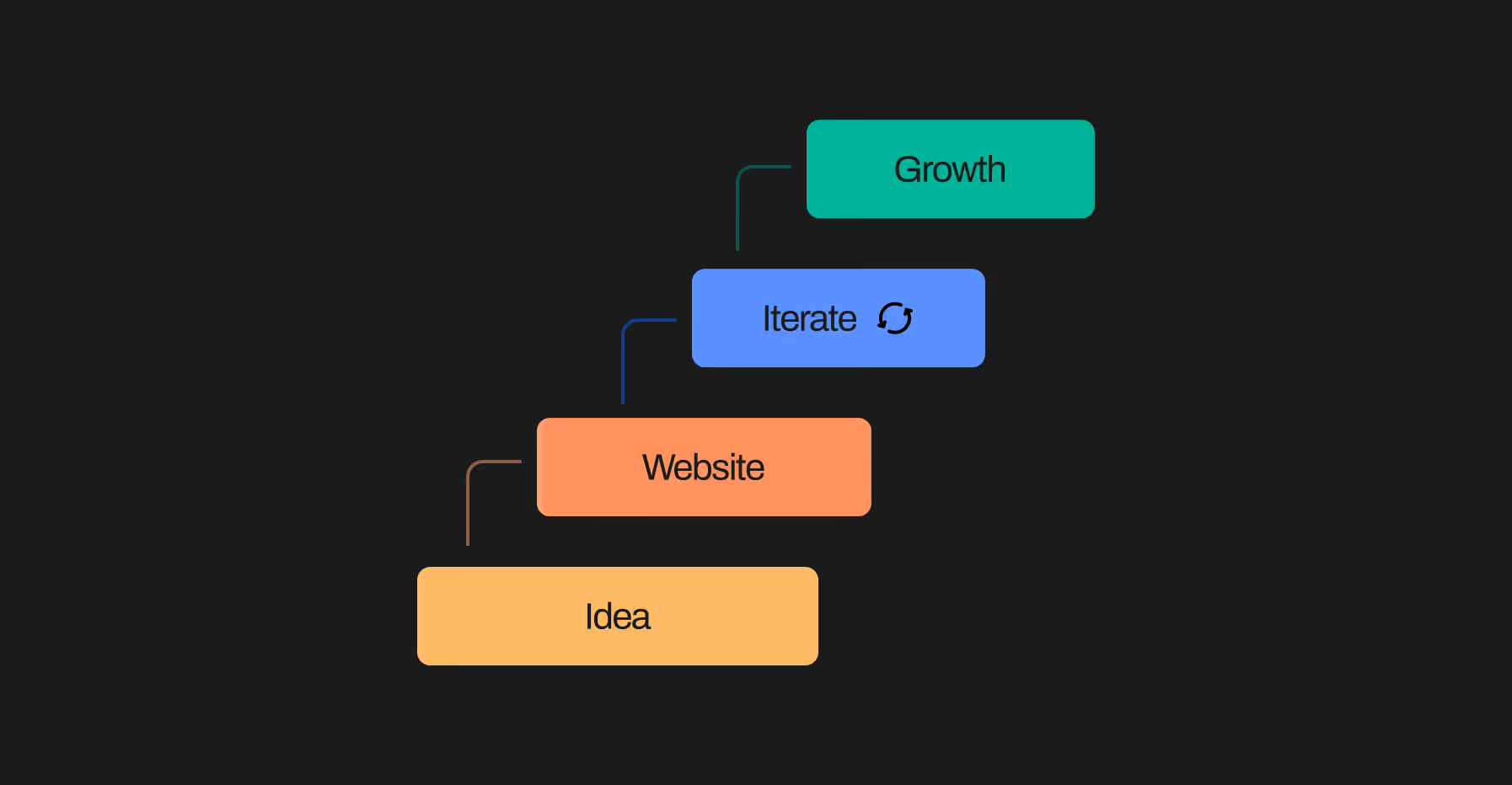
The startups that win are rarely those that ship first. They are those that learn fastest. Learning speed depends on iteration speed. Iteration speed depends on product structure.
Design systems are not about pixels. They are about momentum. In venture-backed environments, momentum compounds. So does disorder. Founders ultimately decide which trajectory they invest in.
Final Thoughts
Startups do not win by launching first. They win by iterating faster. An MVP without structure becomes friction at the exact moment when speed is most critical. Design, in this context, is not decoration. It is execution infrastructure.
At Peppermint, we work with founders to build products that can move fast today and scale confidently tomorrow. Momentum is rarely accidental. More often, it is intentionally designed.